-
 Call Now ! +91-9105912123
 -
 Email Now kumaonmiet@gmail.com
17 Aug 2026
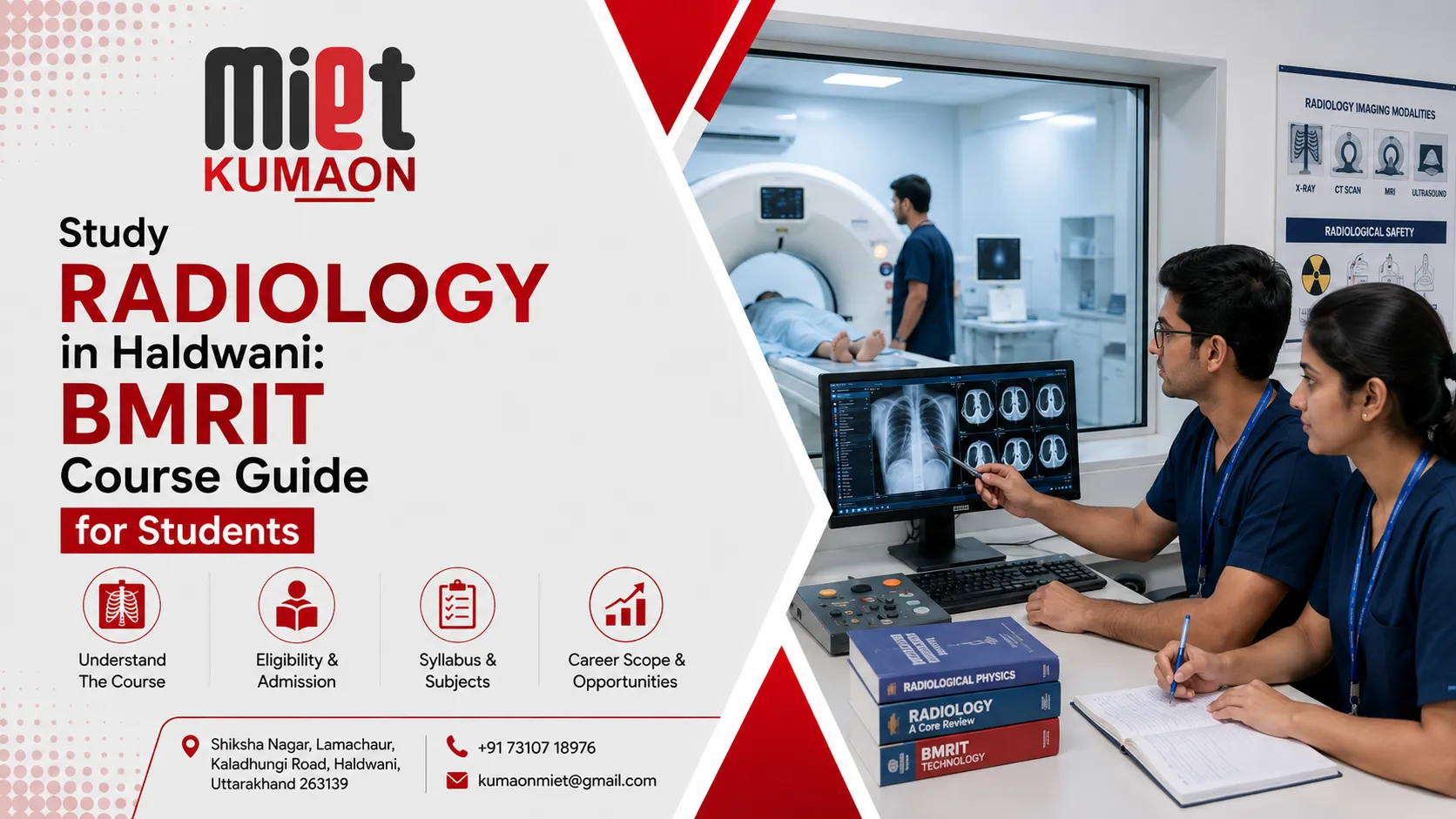
If you've just finished 12th with Physics, Chemistry, and either Maths or Biology, and you're weighing your options in healthcare, chances are BMRIT has come up somewhere — a teacher mentioned it, a relative works in a diagnostic centre, or you stumbled onto it while searching for ways to study radiology in Haldwani. It's not a course most students grow up knowing about the way they know about MBBS or engineering, so a bit of confusion is normal.
This BMRIT course guide for students exists to clear that up. It covers what BMRIT actually is, what studying radiology in Haldwani at MIET Kumaon looks like in practice, and everything in between — eligibility, seats, fees, the syllabus, what your days will actually involve, and what kind of job and salary you can realistically expect once you're done. It's long, on purpose, because the short version leaves out the things that actually matter when you're deciding where to spend three and a half years of your life.
BMRIT stands for Bachelor of Medical Radiology & Imaging Technology. It's an undergraduate paramedical degree built around one core idea: someone has to actually run the machines that produce the X-rays, CT scans, MRIs, and ultrasound images doctors use to figure out what's wrong with a patient. That someone is a radiology or imaging technologist, and BMRIT is how you become one.
It helps to be clear about what BMRIT is not. It's not the same as becoming a radiologist — a radiologist is a doctor who's completed MBBS plus specialisation and spends their time interpreting scans and writing diagnostic reports. A BMRIT graduate works alongside that person, but the role is different: positioning the patient correctly, calibrating and operating the imaging equipment, following radiation safety protocols, and producing an image clean enough for a radiologist to actually read. Both roles matter. Neither works without the other.
The subjects you study reflect that split responsibility. You need enough anatomy and physiology to know exactly what you're imaging and why a particular angle or technique matters. You need physics to understand what's actually happening inside a CT or MRI machine. And you need a working knowledge of patient care, because a decent chunk of the job is guiding someone — often someone anxious or in pain — through a scan safely and calmly.
If you're the kind of person who'd rather be doing something with your hands than sitting through years of theory-heavy classes, and you want a genuine role in a hospital or diagnostic centre without committing to the length of a full medical degree, BMRIT sits in a useful middle ground.
Before going into detail, here's the core information in one place — the numbers most students search for first.
|
Detail |
Information |
|
Course |
Bachelor of Medical Radiology & Imaging Technology (BMRIT) |
|
Duration |
3.5 years, including a 6-month integrated internship |
|
Eligibility |
10+2 in PCM or PCB with a minimum of 45% marks |
|
Total seats |
30 — limited availability |
|
Admission |
As per university/state norms (merit-based) |
|
Affiliation |
Hemwati Nandan Bahuguna Uttarakhand Medical Education University (HNBUMU) |
|
Approval |
Uttarakhand Para Medical Council |
|
Location |
MIET Kumaon, Kaladhungi Road, Haldwani, Uttarakhand |
Keep this table bookmarked — most of the rest of this guide is really just unpacking each of these rows in enough detail to actually make a decision, not just skim past the numbers.
 Why Study BMRIT at MIET Kumaon
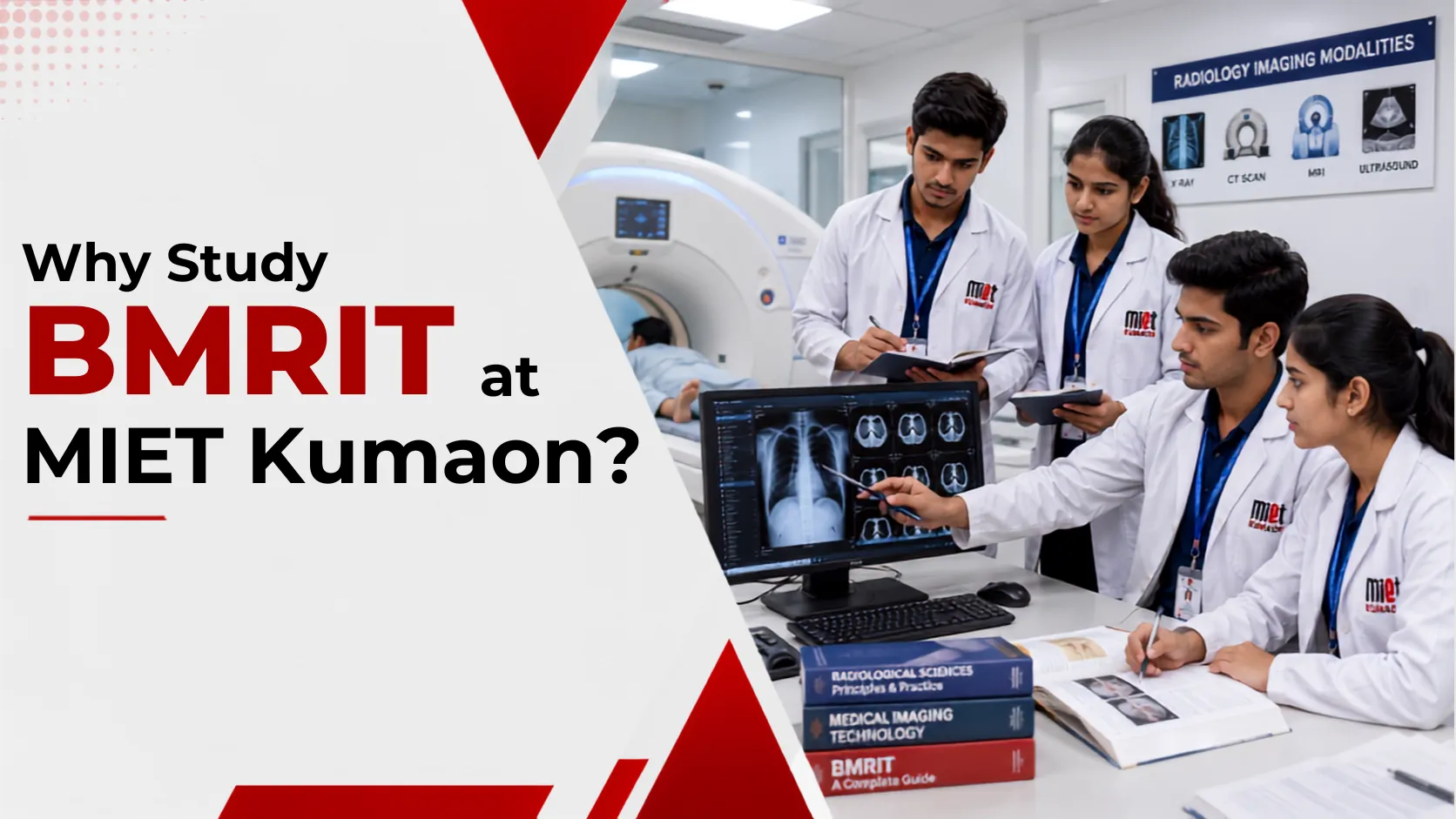
Haldwani isn't the only city in Uttarakhand offering paramedical courses, and MIET Kumaon isn't the only college offering BMRIT. It's worth being upfront about that rather than pretending otherwise. But there are specific, practical reasons students keep choosing this program.
It's not a recently added course. MIET Kumaon has been part of Haldwani's education landscape since 2011, and BMRIT has been offered alongside other established paramedical programs like BPT (Physiotherapy) and BMLT (Medical Lab Technology). That matters because a course that's been running for years has had time to build faculty experience, refine its clinical tie-ups, and iron out the kind of administrative issues that plague brand-new programs.
The affiliation and approval are in order. The degree runs under Hemwati Nandan Bahuguna Uttarakhand Medical Education University and is approved by the Uttarakhand Para Medical Council. This sounds like a formality until you're a graduate trying to register professionally or apply for a government job and discover your degree isn't recognised the way you assumed. Checking affiliation before you enrol, not after, saves a lot of pain later.
The fee is genuinely accessible. At roughly ₹70,000 a year, BMRIT here costs meaningfully less than equivalent programs in Dehradun or further south. Over three and a half years, that difference adds up to something real for a lot of families in the Kumaon region — money that can go toward books, equipment, or simply reducing loan pressure.
Outstation students are actually planned for. Separate hostels for boys and girls with furnished rooms and internet access, and a college-run bus fleet covering routes across Haldwani, mean you're not left to figure out accommodation and daily commuting on your own. A senior medical officer is also available on campus most days — a small detail, but one that matters the first time you actually need it.
None of this is a substitute for doing your own diligence. Visit the campus if you can. Ask current BMRIT students what their internship placements actually looked like. Ask about lab equipment specifically, not just "facilities" in general. A college that's confident in what it offers won't mind those questions.
The formal eligibility is straightforward: 10+2 in PCM or PCB with a minimum of 45% marks. But a few things about that are worth spelling out, because students often assume rules that aren't actually there.
PCM or PCB — you have a choice. Some paramedical colleges insist on Biology specifically. MIET Kumaon accepts either Physics-Chemistry-Maths or Physics-Chemistry-Biology, which opens the door to students who took the Maths stream in school but later decided healthcare was the direction they wanted. If you're in that situation, this flexibility is worth knowing about early, since it's not universal across paramedical programs.
45% is on the accessible end. Compared to some competitive paramedical or nursing programs that ask for 50% or higher, this cutoff gives students with an average — but not top-tier — 12th-grade result a realistic shot at getting in. It's not a course reserved only for board-toppers.
There's no entrance exam to prepare for. Admission is merit-based on your 12th marks rather than a separate competitive test, which simplifies your final year of school — your focus stays on your board exams rather than juggling entrance-exam prep on top of them.
The exact cutoff can shift slightly each year. Because only 30 seats are on offer, and demand for paramedical courses has been climbing steadily, it's worth confirming the current cycle's actual cutoff with the admissions office rather than assuming last year's number still applies.
Admission at MIET Kumaon follows university and state norms, which in practice means a fairly standard, merit-based process. Here's how it typically plays out:
Because seats are limited to 30, timing matters more here than it might for a course with hundreds of seats. Reaching out to the admissions office as soon as your 12th results are out is a reasonable rule of thumb.
BMRIT at MIET Kumaon runs 3.5 years total — three years of academic coursework followed by a 6-month integrated internship. The word "integrated" matters here. Rather than the internship being something you have to scramble to arrange on your own after graduating, it's built directly into the structure of the degree, which means the college takes some responsibility for where you're placed and what you're exposed to during it.
The three academic years aren't structured as pure theory followed by a sudden dose of practical work in year three. Lab sessions and hands-on training run alongside classroom learning from the first year onward, which means by the time you reach your internship, you're not being thrown into a hospital environment cold — you've already had structured exposure to the equipment and the underlying science.
Roughly, the progression looks like this:
This structure is deliberate. Imaging technology and patient safety aren't things you can learn purely from a textbook, so the earlier and more consistently you're exposed to actual equipment, the more confident and competent you are by the time your internship starts.
Exact syllabus content is reviewed periodically to keep pace with changes in imaging technology, so treat the following as a representative structure rather than a fixed, unchangeable list. Broadly, across the program you'll cover:
Foundational sciences
Technical and physics-based subjects
Clinical and patient-facing subjects
Supporting and practical components
If parts of this list — radiological physics especially — sound intimidating right now, that's completely normal. Nobody arrives on day one already understanding how a CT scanner works. That's precisely what the course is designed to build up, step by step, from foundational anatomy in year one to full clinical competence by the end of the internship.
The 6-month integrated internship is arguably the most important part of the entire degree, and it's worth understanding what it actually involves rather than treating it as a formality tacked onto the end.
During this period, you're placed in a clinical environment — typically a hospital or diagnostic centre — where you work under the supervision of qualified radiographers and radiologists. You're not observing from the sidelines; you're involved in actual patient positioning, assisting with scans, following radiation safety protocols in a real setting, and getting comfortable with the pace and pressure of an actual imaging department, which is very different from a controlled lab environment on campus.
This is also where a lot of students figure out which direction they actually want to specialise in — some discover they enjoy the fast pace of X-ray and general radiography, others find they're drawn specifically to CT or MRI work, and a few realise they'd rather move toward research or quality control roles later. The internship is where that clarity usually starts to form, because it's the first time you're doing the job rather than studying toward it.
|
Course |
Duration |
Total Seats |
Annual Tuition Fee (approx.) |
|
BMRIT |
3.5 years (incl. 6-month internship) |
30 |
₹70,000 |
This figure is indicative and subject to revision each academic session, so treat it as a planning reference rather than a locked-in number — confirm the current fee directly with the admissions office before finalising your budget.
Beyond tuition, it's worth budgeting for a few additional, fairly standard costs that most paramedical students end up factoring in: hostel fees if you're staying on campus, transport charges if you're using the college bus service, uniform and lab-coat costs, exam fees, and study materials. None of these tend to be large individually, but it's more useful to plan for them upfront than to be surprised later. The admissions office can give you a fuller breakdown of what's included in the base tuition figure and what's charged separately.
A few practical facilities worth knowing about if you're considering MIET Kumaon specifically:
If any of these details matter significantly to your decision — hostel room-sharing arrangements, specific bus routes, or exactly what equipment the labs currently have — it's worth confirming directly with the college rather than relying solely on this guide, since facilities and arrangements can be updated between academic sessions.
By the time you finish BMRIT, you're not just holding a certificate — you should genuinely be able to do a specific set of things:
These aren't abstract "soft skills" for a resume — they're the actual, checkable competencies that get you hired and that a supervising radiologist trusts you with on day one of a real job.
Once you graduate, the roles you're realistically positioned for include:
Employers span government hospitals, private hospital chains, standalone diagnostic centres, nursing homes, and defence/military hospitals. This isn't a career tied to any one city or state either — hospitals and diagnostic centres exist everywhere, which means a BMRIT graduate from Haldwani has genuine mobility, whether that means staying in Uttarakhand or moving to a bigger city later.
Salary depends heavily on employer type (government versus private), city, experience, and specialisation, but based on how the industry generally pays, here's a realistic range:
|
Career Stage |
Approximate Annual Salary |
|
Entry-level (0–2 years) |
₹2.5 – 3.6 LPA |
|
Mid-career (5–7 years) |
₹4.5 – 6.6 LPA |
|
Senior / specialised (CT, MRI, PACS) |
₹6.6 – 9 LPA and above |
A few factors that reliably push earnings upward: specialising specifically in CT or MRI rather than staying generalist, moving to larger hospital chains or metro cities once you have a few years of experience, and picking up additional certifications along the way. Government hospital roles often come with slower initial growth but stronger long-term stability and benefits, while private hospitals and diagnostic chains can offer faster salary growth for technologists who prove themselves quickly.
BMRIT isn't necessarily a terminal degree. If you want to go further, common paths include:
None of these are required to start working most BMRIT graduates go straight into a technologist role after their internship but they're worth knowing about if you're thinking several years ahead rather than just at the first job.
This course tends to be a good fit if:
It's probably not the right fit if you're specifically looking to become a doctor who diagnoses and treats patients directly (that's a different, longer path through MBBS and specialisation), or if you're not comfortable with the more technical, physics-heavy side of the coursework.
"Radiology technologists just push a button." Not even close. Positioning a patient correctly, choosing the right technique for a specific diagnostic question, and maintaining image quality under radiation-safety constraints is a skill that takes real training to develop.
"AI is going to replace this job." AI-assisted imaging tools are becoming more common, but they're increasing demand for technologists who understand both the technology and the clinical workflow around it — not eliminating the role. Someone still has to operate the equipment, manage the patient, and ensure the output is usable.
"You need Biology specifically to qualify." At MIET Kumaon, PCM is accepted alongside PCB, so students without Biology in 12th aren't automatically excluded.
"This is a dead-end job with no growth." Specialisation in CT, MRI, or interventional radiography, along with postgraduate study, genuinely does move salary and responsibility upward over time — it isn't a role where you're stuck at entry-level pay indefinitely.
A typical week as a BMRIT student mixes classroom lectures, lab sessions where you're actually handling equipment, and — particularly in the later years — time in clinical settings. It's not a light course; radiological physics and anatomy both require real study time, and the practical components mean you can't simply cram before exams the way you might for a purely theory-based subject.
That said, it's not relentless either. Outside of coursework, campus life includes the usual mix of hostel routines, college events, and the kind of friendships that tend to form when a small cohort — remember, only 30 seats — goes through a demanding, hands-on course together. Smaller batch sizes often mean more direct faculty attention than you'd get in a mass-enrolment program, which some students find genuinely useful when they're struggling with a specific concept.
Haldwani's position as the gateway to the Kumaon region gives it a few practical advantages for paramedical students specifically. It has a growing base of hospitals and diagnostic centres, which matters for clinical exposure and internship placement. Cost of living is meaningfully lower than Dehradun or metro cities, which adds up over three and a half years of tuition, hostel, and daily expenses. And it's well connected to Delhi NCR and the rest of North India, so getting home during breaks — or having family visits — isn't a logistical headache.
India's diagnostic imaging market has also been expanding steadily, driven by a rising chronic disease burden, an ageing population, and hospital chains increasingly setting up in tier-2 cities rather than sticking exclusively to metros. That expansion is happening in places like Haldwani too, not just in Delhi or Mumbai — which means the job opportunities this course leads toward aren't confined to wherever you happen to study.
BMRIT isn't a course that comes with much glamour attached — nobody's making television shows about radiology technologists. But it's a genuinely stable, in-demand career that doesn't require the decade-plus commitment of a full medical degree, and it puts you in a hands-on, patient-facing role from very early in your career. If you've decided to study radiology in Haldwani, MIET Kumaon offers an affiliated, council-approved BMRIT degree, real lab and clinical exposure built into the structure rather than tacked onto the end, and a campus that's genuinely set up for students coming from outside Haldwani.
If the trade-offs here — 3.5 years, a physics-heavy curriculum, hands-on clinical work — sound right for you, the next step is simple: reach out to the MIET Kumaon admissions office directly for the current academic session's exact dates, confirm the latest fee structure, and, if you can, visit the campus before you commit. Seats are limited to 30, so it's worth not waiting until the last minute once your 12th results are out.
Find answers to common questions about Uttarakhand Board Result 2026.
No FAQs available for this post.
Planning a career in nursing? Explore the GNM Nursing Course in Haldwani to lear...
Read More →
Planning to pursue BCA in Haldwani? Learn what students should check before enro...
Read More →
Short Description Discover how BCA students can build a successful AI career in...
Read More →
MIET Kumaon is a paramedical college in Haldwani offering career-focused program...
Read More →
Discover a nursing college in Haldwani that combines academic learning with prac...
Read More →Apply now to secure your future with world-class education, expert faculty, and industry-focused programs designed for success.